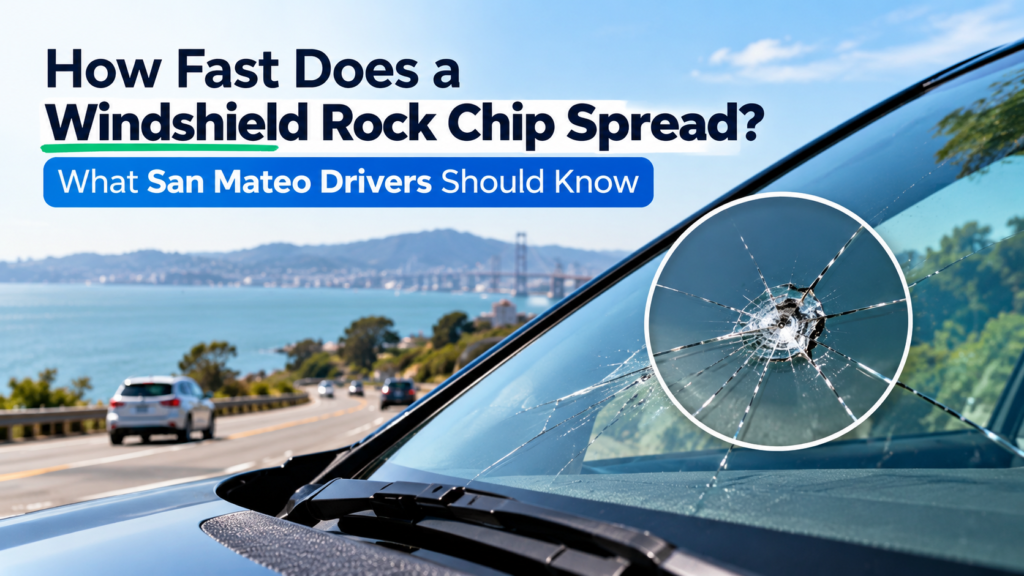
It usually happens in an instant. A sharp tick against the glass on the freeway, a glance up, and there it is: a small pit or star in the How Fast Windshield Rock Chip Spread Sanmateo that was not there a moment ago. Most drivers feel a flash of annoyance, then a question that matters more than the chip itself. How long do I have before it turns into a crack?
The honest answer is that it depends, and the answer can range from a few hours to many months. Glass does not follow a timetable. It follows physics, and the physics are shaped by the type of chip, where it sits, what the weather does, and how the vehicle is used. This article explains how a rock chip behaves inside the glass, which conditions make it spread faster, what a typical timeline looks like, and what drivers around the Peninsula can reasonably do while they wait. It focuses on understanding the process, so the signs make sense when they appear.
What Is Actually Happening Inside the Glass
A modern windshield is laminated safety glass. It is made of two layers of glass bonded to a clear plastic interlayer, usually polyvinyl butyral, which holds the pieces together if the glass breaks. When a stone strikes the outer layer, the impact crushes a tiny area and sends stress outward through the surrounding glass.
The damage often has a visible center, a small pit where glass was removed or pulverized, and fine fractures radiating from it. The inner layer and the plastic interlayer usually remain intact, which is why a chipped windshield still functions as a barrier. The chip is a stress concentrator. The glass around it is under tension, and a tiny flaw at the tip of a fracture can lengthen when more stress is applied.
This is the key idea behind chip spreading. The glass does not heal. Each time it is flexed, heated, cooled, or jolted, the stress at the tip of the fracture is reinforced, and sooner or later the weakest direction gives way and the crack extends.
Types of Chips and Why They Behave Differently
Not every chip is the same, and the shape tells you something about how likely it is to travel.
Bullseye. A circular dark spot, often with a clean, round edge. These are relatively stable because the stress is spread evenly around the impact. They are less likely to spread quickly, though they are not immune.
Half-moon. A partial circle, sometimes with a small crack radiating from it. They behave similarly to bullseyes but can extend if the arc is unsupported.
Star break. A central point with several short legs radiating outward. The legs are already fractures, and each one has a tip that can lengthen. Star breaks are among the more likely to spread, especially if the legs are longer.
Combination break. A mix of a bullseye and a star, often with a crushed center and radiating cracks. These are more complex and tend to be more vulnerable.
Surface pit. A tiny nick that does not reach the plastic layer. These are often harmless for a long time, though they can collect dirt and become a starting point.
Edge chip. A chip within a couple of inches of the glass perimeter. These behave very differently because the glass near the edge is under higher stress from the frame, and they are more likely to run.
As a general principle, more legs, longer legs, and positions near the edge mean faster spreading.
So How Fast Does a Chip Spread?
There is no single answer, but ranges help.
- Within hours or days. This happens when a chip is already stressed, such as a star break or an edge chip, and then meets a strong trigger like a hard temperature change or a heavy bump. A crack can shoot across several inches in seconds.
- Within weeks. Many chips extend gradually through repeated small stresses. A tiny leg grows a little each time the car goes through a temperature cycle.
- Over months or longer. Small, round bullseyes in low-stress areas of the glass can sit unchanged for a long time, though dirt and moisture may make them look worse even when they have not grown.
The unsettling part is that a stable chip can become unstable suddenly. A chip that has been quiet for six months can run on the first cold morning with a hot defroster blast. For that reason, treating any chip as potentially active is the more cautious reading.
The Main Triggers That Make Chips Spread
Temperature Changes
Glass expands when heated and contracts when cooled. When temperature differs across the windshield, one area expands faster than another, and the stress concentrates at flaws. The classic example is turning on the defroster at full heat on a cold morning, which heats the inside surface quickly while the outside is still cold. The same happens with cold air conditioning on a hot, sun-baked windshield.
The Peninsula has a mild climate, but daily swings still occur. Cool, foggy mornings in San Mateo can be followed by warm afternoons, and cars parked in the sun can have a windshield surface much hotter than the air. These repeated cycles are slow-acting but real.
Vibration and Road Shock
Every pothole, expansion joint, and rough patch of pavement sends vibration through the body of the car into the glass. A chip located near the center of the windshield tolerates this better than one near the edge, but constant vibration still works on weak points.
Commutes across bridges, along highways like Highway 92 and Highway 101, or over uneven city streets add up. Construction zones are another source, with grooved pavement and uneven surfaces that are particularly hard on windshield damage.
Door Slams and Body Flex
Closing a door hard creates a pressure pulse inside the cabin that can push on the glass. On a vehicle with a chip, that pulse can be enough to extend a crack, which is why chips are said to spread when you slam a door. Cars also flex slightly when driven over uneven ground, such as when one wheel goes into a dip.
Moisture and Contamination
Once a chip opens to the air, dirt, water, and car wash soap can find their way into the break. Contaminants can be difficult to remove later, and water that freezes and expands in colder climates can force a crack open. In the Bay Area, freezing is rare, but moisture still discolors chips, fills fractures with residue, and interferes with clear repair.
Pressure Washing and Car Washes
High-pressure water jets and hot wash cycles can place sudden stress on a damaged windshield, especially if the water is warm and the glass is cold. Touchless washes with strong jets can force water into a chip.
Chip Location and Size
A chip in the driver’s line of sight is more important for safety, but chip location also affects spread. Chips near the edge are generally more dangerous in terms of cracking. Chips directly on the lower edge, near the cowl, or over the metal frame can propagate faster because that area is stiffer and carries more stress. Larger chips, particularly those bigger than a quarter, have longer fractures and more potential to spread.
A Closer Look at Seasonal and Local Conditions
San Mateo has a mild Mediterranean-style climate, with cool, damp winters and dry summers. It rarely sees extreme cold or heat, which is a point in favor of stability. But three local conditions are worth noting.
First, the marine layer. Foggy mornings bring cool, moist air, and a windshield that has been sitting in damp air will respond sharply when the defroster blasts warm air onto it. Gentle, gradual warming reduces that effect.
Second, inland heat days. When warm weather pushes temperatures up, a car parked in direct sun can reach interior temperatures far above the outside air. The windshield absorbs heat unevenly, particularly where there is a sunshade or a dashboard shadow, and the uneven heating stresses the chip.
Third, driving patterns. Commuters who spend time on highways at speed, then cross bridges and merge onto busy corridors, put a lot of cycles on the glass. Tiny stones and grit on freeway lanes also mean that new impacts are common, and a second chip near the first can interact with it.
Warning Signs That a Chip Is Starting to Spread
A chip that is about to grow often gives hints. Look for:
- A thin line extending from the chip that was not there before
- A new leg on a star break
- A chip that has grown in diameter or appears darker or dirtier
- A faint line that appears after a cold start or after a bump
- A change in the way light bends through the damaged area
Checking a chip once a day for a week gives a quick sense of whether it is stable. A smartphone photo taken in consistent lighting is a practical way to compare, and holding a small ruler or coin next to the chip gives a size reference.
What Drivers Can Do While the Chip Is There
While a chip cannot be undone by home measures, a few habits reduce the chance of spreading and protect the break from contamination.
- Cover the chip. A piece of clear tape over the outside of the chip keeps out water and dirt. It does not strengthen the glass, but it prevents contamination that complicates later repair.
- Avoid extreme temperature changes. Use the defroster and air conditioning gradually. Starting on low and moving up lets the glass warm evenly.
- Park in shade or a garage when possible. Reducing sun exposure lowers the temperature swing across the glass.
- Close doors gently. Opening a window slightly before shutting the door lets the pressure escape.
- Skip pressure washing. Hand wash the area carefully, and avoid directing hot water at the chip.
- Avoid rough roads when you can. Slow down over bumps and avoid potholes.
- Do not apply glue or super glue. Household adhesives can contaminate the break and make professional repair harder or impossible.
These are stopgaps. Their purpose is to buy time and preserve the condition of the chip, not to stabilize it permanently.
When a Chip Can Still Be Repaired and When It Cannot
Glass repair relies on filling the damaged area with a clear resin that bonds the fracture and restores some of the glass’s strength and clarity. Whether that is possible depends on a few factors.
Chips generally need to be smaller than about a quarter in diameter, and cracks usually need to be shorter than a few inches, although guidelines vary. The damage should not have penetrated both layers of glass, and it should not be contaminated with dirt or moisture to the point that the resin cannot flow in. Damage in the driver’s primary viewing area is often treated more conservatively because even a successful repair can leave slight distortion. Damage at the edge of the glass is more likely to require replacement.
The longer a chip sits open, the less likely it is to be clean and the more likely it is to have grown. That is why the time between the impact and the first look matters more than most people assume.
Safety and Legal Considerations
A chip is not just cosmetic. The windshield contributes to the structure of the vehicle and supports airbag deployment. A damaged area can weaken that structure slightly, and a growing crack can reduce visibility, especially in glare at sunrise or sunset.
California rules generally prohibit driving with a windshield damaged in a way that obstructs the driver’s view, and a large crack in the driver’s sightline can lead to a citation. Even without a citation, a damaged windshield can interfere with the cameras and sensors used in driver assistance systems, which are often mounted behind the glass near the rearview mirror.
Common Myths About Rock Chips
“If it is small, it will stay small.” Small chips can spread quickly, and size alone does not predict stability.
“Clear tape fixes it.” Tape protects against contamination but does not mend the glass.
“Only cold weather cracks glass.” Heat and rapid temperature changes both cause stress. Hot weather and strong air conditioning can crack a windshield.
“Chips only matter if they are in my line of sight.” A chip anywhere on the windshield can spread across the glass and into the driver’s view.
“A chip will not affect safety.” A weakened windshield affects structural performance and sensors.
Frequently Asked Questions
How long does it take for a windshield chip to turn into a crack?
It can take anywhere from a few hours to many months. Star breaks, edge chips, and damaged areas exposed to sudden temperature changes are the fastest. Small, round chips in the center of the windshield can stay stable for a long time.
Will a rock chip always spread?
Not always. Some chips remain unchanged for years, but there is no way to predict this with certainty. Any chip is a weak point, and conditions that stress the glass can cause it to grow.
Does driving make a chip spread faster?
Yes, in many cases. Vibration, road shock, and body flex all put stress on the glass. Rough roads and potholes are the worst, while smooth highway driving tends to be gentler.
Can a car wash make a chip worse?
It can. High-pressure jets and hot water can stress the glass or push water and soap into the chip. Hand washing gently around the damaged area is a safer approach.
Is it safe to use the defroster with a chipped windshield?
It is generally fine if used gradually. The risk comes from blasting very hot air onto cold glass. Starting at a lower temperature and increasing slowly reduces the stress.
Why did my chip spread overnight?
Temperature changes overnight, such as a cold, damp night followed by a quick morning warm-up, can create stress that extends a fracture. Moisture in the chip can also contribute.
What size chip can be repaired?
Many chips smaller than a quarter can be repaired, provided the damage is clean and not too close to the edge. Cracks of a few inches may also be candidates. Guidelines vary by situation, which is why a quick assessment matters.
Does the type of chip affect how fast it spreads?
Yes. Star breaks and combination breaks, which have radiating legs, tend to spread faster than simple bullseyes. Edge chips are also more likely to run than chips in the center.
Final Thoughts
A windshield chip is a small event with an uncertain future. The glass around it is under stress, and anything that adds to that stress, from a cold morning to a hard door slam, can push a tiny fracture into a long crack. The speed depends on the type of chip, its position, the weather, and the road.
For anyone wondering how fast a windshield rock chip spreads in San Mateo, the most useful approach is to treat the damage as active, protect it from dirt and moisture, avoid sudden temperature changes, and watch for early signs of growth. Understanding what drives the spread turns a vague worry into a set of simple, manageable habits.